System Does Meta
 Mörk Borg's forlorn philosopher
The rumour1
This reddit thread got me thinking for quite awhile about how to fit TTRPGs in the western-leaning cultural landscape. How do you evaluate a game as being modern? Post-modern? Meta-modern even?
It depends
As it always does. What are the aspects that should be analyzed to determine how specific games align aesthetically/philosophically to this cultural currents?
Of the many aspects that may define a system, I think three are the most relevant here, in no particular order:
- the self/character portrayal
- the rules
- the theme/setting
Of these aspects, I'm focusing on the self and the rules. I'm choosing to not look into the theme for one main reason: it's the point most prone to be significantly altered by play ("how do I adapt D&D for [non-medieval-fantasy-theme]?" is a common question) or table culture. Two minor reasons are that sometimes a system has no defined theme (generic systems!) or the theme/setting is purposefully vague (e.g., Into the Odd).
On the other hand, while the position of the characters and the rules are subject to the same strong influences of play and table culture, they're less likely to stray too far from the initial proposition of a given system. The treatment of the self and the rules are usually strongly tied to one another, as rules are mostly built around actions made by or towards characters. Thus strongly altering one without the other will likely only achieve a poor experience, and altering both is akin to creating a new system or spinning one off so significantly that it becomes a game in itself, meriting an independent eval of it.
The map
We're mapping the self and the rules to how 20th and 21st centuries diverse cultural thinking see these themes. This is a broad and complex reading, but I'm limiting them to specific definitions that I feel capture the general geist of specific currents of thought, and also because my understanding of them is not that of a refined scholar, but of a curious person.
Additionally, I'm doing so in a way that allows to do a neat 2x2 plot at the end of this article, because CHARTS.
The Self
...as seen by modernists: the hero. Coherent, linear, objective. A force to be reckoned with. A central pilar of what happens in the world and in every story. The Hero With a Thousand Faces is released in 1949, and is the modern framework for storytelling by excellence.
...as seen by post modernists: the fragmented cliché. The character is a collage of archetypes, narrative tropes. They're a participant in a chaotic and vastly indifferent world. Things happen and they might be involved or not. They might be aware, or not.
...as seen by metamodernists: the world is vast and indifferent and yet the character participates in it willingly and sincerely. To the best of his efforts, the character moves in what they know is a merciless world, and the irony of posing as a hero in a story that's not centrally about their deeds is not lost to them. They're aware of all the clichés they're partaking in, yet they do so wholeheartedly.
If seen as a spectrum, on one end the self/character is peripheral to the world and story, and on the other the self is central and necessarily heroic. Midway is where the self is aware of it's dubious relevance and irrelevance, and embraces each role wholeheartedly.
The Rules
Or how much does a modern/postmodern/metamodern individual trust authority?
...as seen by modernists: dice are in the the foreground of play. Without the dice, there's no play, only an indulgent make believe. The system is how it is for a Reason, and questioning it is unproductive for play. "Rules as written."
...as seen by post modernists: dice are optional. Rules are only important if they serve the play. They're not law, and should be tampered with and ignored if they don't fit the fiction. "Lead with the fiction."
...as seen by metamodernists: dice are there, wether you want it or not, whether as rolling solids or cue taking from your peers. Once you acknowledge this, you'll be able to choose when to lean on them, or step away from them, to better suit your table, your play or your story.
If seen as a spectrum, on one end dice is completely optional, on the other it is complete crucial and mandatory. Midway is dice is there, and you engage with it consciouslly.
The Crawl
(Almost) No game is going to define itself in the terms I'm using above, so we need a way to evaluate how systems see the characters, and how they understand the relevance of their own rules.
For the character/the self, I find games define their stance via two main aspects: how characters progress and how they die.
When self is central:
- character progression is a core part of the system, and is a prize in itself
- zero-to-hero is the expected trajectory
- more often than not, characters end up all powerful
- character death is rare by default, unexpected
- combat is expected to be balanced and this is ruled as fair, with unbalanced being unfair and a bad game practice
- violence is a preferred means of conflict resolution
When self is peripheral:
- progression is absent or marginal
- when it happens, more often than not it requires narrative coherence (e.g., through loot or diegetic training, for instance)
- character death is a constant presence by default, expected
- combat is not expected to be balanced, and this is seen as neutral, neither fair or unfair, and this is considered a good/coherent game practice
- violence is one of many means of conflict resolution, usually not the preferred or optimal
For the rules, also two cues are important to understand how a game positions itself: dice density, meaning how specific and wide in coverage are rules to define outcomes of actions, and how they treat ambiguity.
High dice density means:
- an attack turn often than not takes over 2 dice rolls to be resolved
- social situations are outlined by dice rolls
- you roll to know things from your past
- you roll to know things from the environments past or context
- modifiers stack vertically and could be limitless
- grids are preferred or required
- ambiguity are edge cases, and while the referee has the final word, rules lawyers will likely object
Low dice density means:
- an attack turn most often than not takes 2 or less dice rolls to be resolved
- "lead with the fiction", "roll when stakes are high", "rules over rules"
- social situations are resolved through role play
- the referee will give you information your character should know freely
- wits resolve situations more often than dice
- theater of mind is preferred, grids never required
- ambiguity is abound and resolved by rulings (see above), rule of cool, collaboration or the referee without much fuss
The loot
How about that? We have two dimensions with opposite directions! Convenient for a 2x2 grid so we're able to plot stuff there, right?
Almost as if I purposefully watered things down to be able to make a point! Huh, surely reality is this simple and this is not what I did.
Be that as it may, we'll enjoy the treasure.
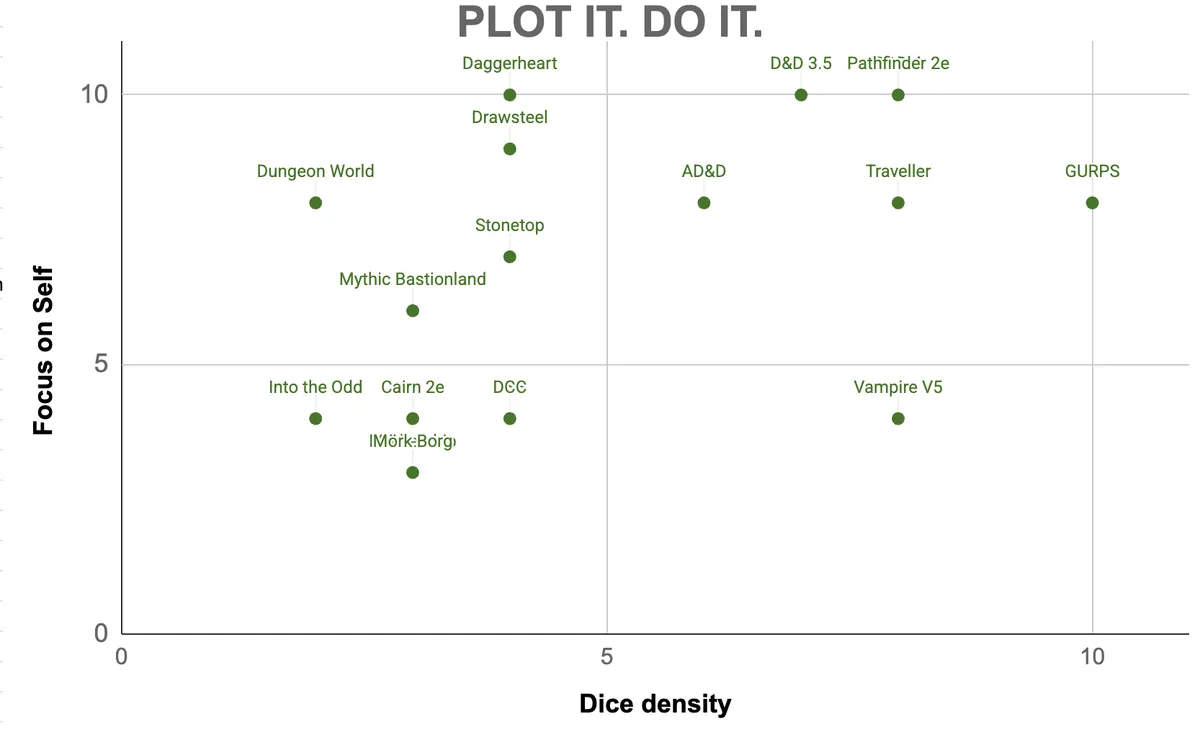
What a mess, right?
1-10 are the arbitrary grades I gave for theses systems which I have some grasp on. 1 means less dice density or less focus on self, 10 means more of it. Low dice density and low focus on self could be read as more plainly post-modern, whereas low dice density but moderate focus on self meta modern, while low dice density and high focus on self is more diverse in how it frames itself, and harder to fit in a single definition (but more akin to meta modernism self awareness, I'd say).
There's a curious gap in high dice density and low focus on self - but this is more due to my ignorance of diverse systems instead of a specific trend. (Though it's fair to argue that the higher the reliance on a system of rules, more the system tends to care about the character, since rules exist mostly to advance or hamper a characters actions in a given game.)
The aftermath
I find this idea enticing, even if I've not executed it to a satisfactory end. Still, it's fair to say that there's a lot of cultural depth to how any given system comes to life, even if there's not much awareness about it. We're highly influenced by media, peers, other games, and these currents of thought infiltrate on our designs.
I hope to improve on this and do a decent job at publishing it in the future, but no promises (my second daughter is 5 days old, and I'll eventually come back to work). I will, regardless, be using this type of thinking in other posts.
Be merry, all the love.
This is a simplified, flawed and reckless attempt at fitting a very broad and diverse genre of fun into nuanced, deep and disputed cultural landscapes. It's a western view by a western person. By all means please criticize the text and ideas, let's talk it out.↩